
Best Class 12 Commerce Accountancy Numerical Notes Solutions – Comprehensive Guide for CBSE & JK Board Exam Preparation
Accountancy is a crucial subject for Class 12 Commerce students, forming the foundation for careers in finance, business, and accounting. To help students excel in their exams, well-structured Class 12 Accountancy notes are essential especially the numerical part. Numerical problems form a significant part of the NCERT Or CBSE syllabus, requiring a clear understanding of concepts and practice. This article provides a detailed guide to solving Class 12 Commerce Accountancy Numerical Notes Solutions and Problems effectively while ensuring accuracy and conceptual clarity.
Read Also : JKBOSE New Syllabus Notes for Class 10 11 12
This article provides a detailed overview of key topics, chapter-wise summaries, and tips for effective preparation and all this comes under our Best Class 12th Commerce Accountancy Handwritten Notes for the session 2025- 26.
Click Here For Best, Short & Easy JKBOSE | CBSE | NCERT Handwritten & Full Notes
Chapter-wise JKBOSE Class 12 Accountancy Notes 2025-2026
Part A: Accountancy Partnership Firms and Companies
1. Accounting for Partnership Firms – Fundamentals
– Definition and features of a partnership.
– Partnership Deed and its importance.
– Profit & Loss Appropriation Account.
2. Reconstitution of Partnership (Admission, Retirement, Death)
– Calculation of new profit-sharing ratio.
– Treatment of goodwill and revaluation of assets/liabilities.
– Adjustment of accumulated profits/losses.
3. Dissolution of Partnership Firms
– Difference between dissolution of partnership and firm.
– Settlement of accounts under the Garner vs. Murray rule.
4. Accounting for Share Capital (Companies Act)
– Issue of shares at par, premium, and discount.
– Forfeiture and re-issue of shares.
– Disclosure requirements in financial statements.
Part B: Financial Statement Analysis
5. Financial Statements of a Company
– Balance Sheet and Statement of Profit & Loss.
– Comparative and Common Size Statements.
6. Ratio Analysis
– Liquidity, Solvency, Activity, and Profitability Ratios.
– Interpretation of accounting ratios.
7. Cash Flow Statement (As per AS-3)
– Operating, Investing, and Financing Activities.
– Direct vs. Indirect method of cash flow calculation.
Note : Kindly Check Latest JKBOSE Commerce Syllabus 2025 2026 before going through ous Commerce Study Material
Accountancy Solved Numericals with Examples
Accountancy without Numericals is just a human without soul, so it is necessary to revise all the numericals problems by learning all the related concepts. While you can wonder about ways to get hands on Toppers Handwritten Accountancy Solved Numericals, we might be of some help in that endeavor.

If you want handwritten notes for Solved Numericals of Commerce, then stay care free as we got you covered with our study material that includes most important Numerical Questions. Most important topics include Admission of a Partner with examples, Partnership Firms, Dissolution of a Firm etc
You can get them by contacting the number below :
Contact / WhatsApp : +919103270253
1. Accounting for Partnership Firms
Accounting for partnership firms is an important aspect of managing a business where two or more individuals come together to operate under a mutual agreement. Unlike sole proprietorships, partnerships involve shared responsibilities, profits, and liabilities. Proper accounting ensures transparency, legal compliance, and smooth financial operations.
Partnership accounting involves profit-sharing, interest on capital, and adjustments. Here’s a common Accounting for Partnership Firm Numerical Example:
Numerical Problem:
A and B are partners sharing profits in the ratio of 3:2. Their capitals are ₹50,000 and ₹30,000, respectively. Calculate interest on capital @5% p.a.
Solution:
– Interest on A’s capital = ₹50,000 × 5% = ₹2,500
– Interest on B’s capital = ₹30,000 × 5% = ₹1,500
2. Goodwill Calculation Examples :
Goodwill represents the firm’s reputation and earning capacity. Existing partners are compensated for their sacrifice in profit share.
Methods to Value or Calculate Goodwill:
- Average Profit Method – Based on past earnings.
- Super Profit Method – Excess profits over normal returns.
- Capitalization Method – Estimating value based on expected returns
Numerical Problem on Goodwill Calculations:
Calculate goodwill based on 3 years’ purchase of the average profit of the last 4 years: ₹20,000, ₹25,000, ₹30,000, ₹35,000.
Solution:
– Total profit = ₹20,000 + ₹25,000 + ₹30,000 + ₹35,000 = ₹1,10,000
– Average profit = ₹1,10,000 / 4 = ₹27,500
– Goodwill = ₹27,500 × 3 = ₹82,500
3. Admission of a Partner with Examples :
The concept of admission of a new partner is a significant event in the life of a partnership firm, altering its financial structure, profit-sharing dynamics, and managerial responsibilities.
New partner admission affects profit-sharing ratios and requires asset revaluation. Here’s example of Admission of a Partner with Examples Questions
Numerical Problem:
X and Y share profits in 3:2. Z is admitted for 1/5th share. Calculate the new profit-sharing ratio.
Solution:
– Remaining share = 1 – 1/5 = 4/5
– X’s new share = 3/5 × 4/5 = 12/25
– Y’s new share = 2/5 × 4/5 = 8/25
– Z’s share = 1/5 = 5/25
– New ratio = 12:8:5
4. Retirement of a Partner
Retirement leads to adjustments in capital and goodwill.
Retirement of Partner Numerical Problem:
P, Q, and R share profits in 5:3:2. Q retires, and P & R decide to share future profits equally. Calculate the gaining ratio.
Solution:
– Gaining ratio = New ratio – Old ratio
– P’s gain = 1/2 – 5/10 = 0
– R’s gain = 1/2 – 2/10 = 3/10
– Gaining ratio = 0:3
5. Cash Flow Statement
A cash flow statement includes operating, investing, and financing activities.
Problem:
Calculate cash flow from operating activities:
– Net profit: ₹1,00,000
– Depreciation: ₹20,000
– Increase in debtors: ₹10,000
Solution:
– Cash flow from operations = Net profit + Depreciation – Increase in debtors
– = ₹1,00,000 + ₹20,000 – ₹10,000 = ₹1,10,000
6. Dissolution of Partnership Firm Numerical Problems
Dissolving a partnership firm is a significant decision that marks the end of a business relationship between partners. Whether due to disagreements, financial challenges, or the completion of a business venture, the process must be handled legally and professionally to avoid disputes. This guide covers the meaning, reasons, legal procedures, and consequences of dissolving a partnership firm, ensuring a smooth transition for all parties involved.
Numerical 1: Dissolution with Full Realization
Scenario:
Partners A, B, and C share profits in 3:2:1.
Balance Sheet Before Dissolution:
Liabilities Amount (₹) Assets Amount (₹)
Creditors 50,000 Cash 10,000
A’s Loan 20,000 Debtors (₹60,000 – Provision ₹5,000) 55,000
Capital: Stock 40,000
– A: 60,000 Machinery 1,00,000
– B: 40,000
– C: 30,000
Total 2,00,000 Total 2,00,000
Dissolution Process:
Assets Realized:
Debtors: ₹52,000 (₹55,000 – ₹3,000 bad debt).
Stock: ₹38,000.
Machinery: ₹95,000.
Total Realization = ₹52,000 + ₹38,000 + ₹95,000 + ₹10,000 (cash) = ₹1,95,000.
Liabilities Paid:
Creditors: ₹50,000.
A’s Loan: ₹20,000.
Total Payments = ₹70,000.
Remaining Amount: ₹1,95,000 – ₹70,000 = ₹1,25,000.
Capital Settlement (Profit & Loss on Realization):
Book Value of Assets Sold: ₹55,000 (Debtors) + ₹40,000 (Stock) + ₹1,00,000 (Machinery) = ₹1,95,000.
Realized Value: ₹1,95,000 (same as book value → No profit/loss).
Final Distribution:
A: ₹60,000
B: ₹40,000
C: ₹25,000 (₹30,000 – ₹5,000 adjustment
How To PDF Download Commerce Accountancy Handwritten Notes Solutions for Class 11th 12th
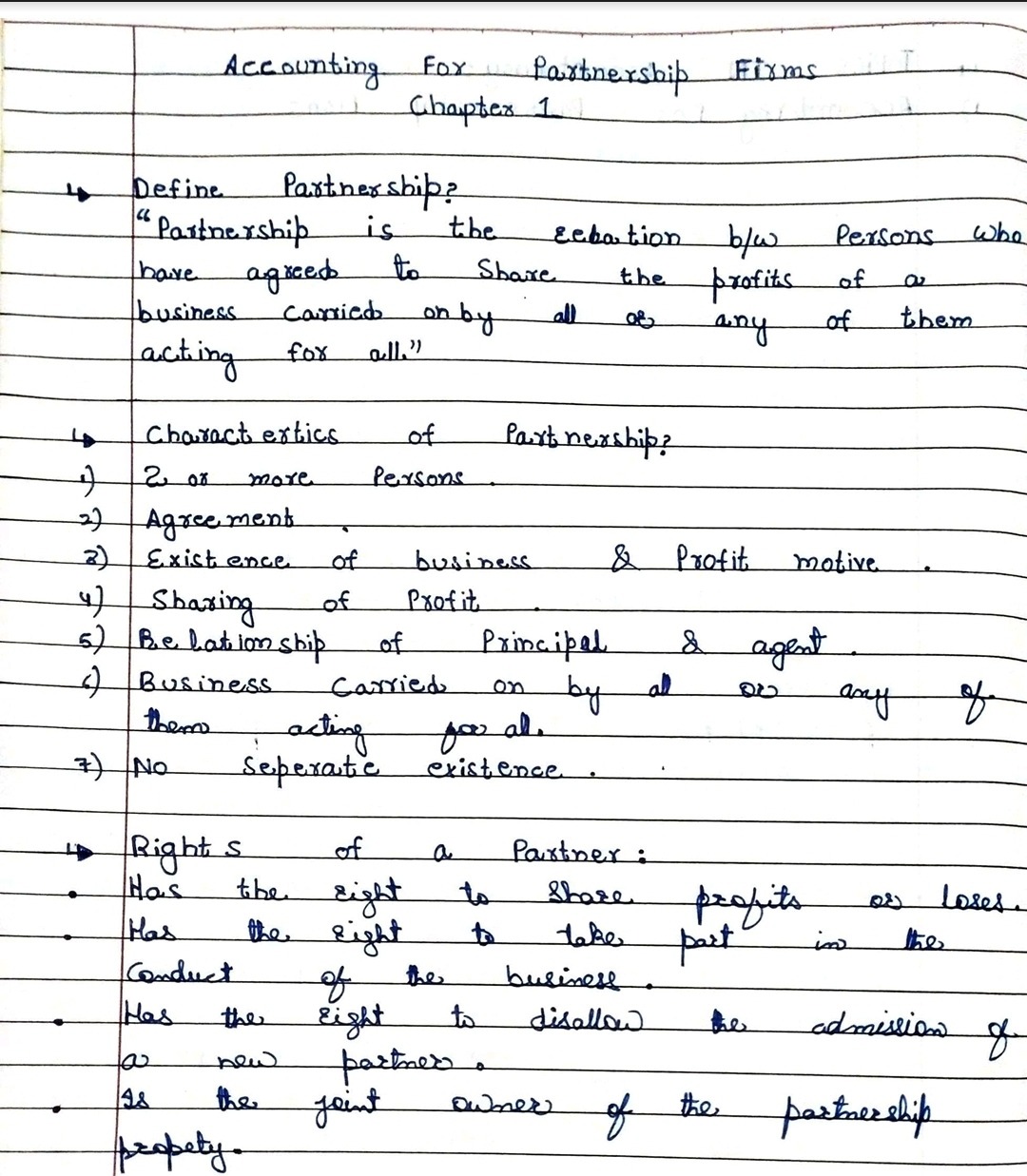
Well if you want to download our Toppers Handwritten Accountancy Notes for Class 12, you can do so by following steps. These notes include almost all the important accountancy numericals. The best part is that the numericals are solved by toppers and are study friendly. These study materials include JKBOSE Class 12 Accountancy Notes and are mostly compatible with other state boards also.
In order to go for Accountancy Solved Numericals PDF download, contact the below number :
Contact / WhatsApp : +919103270253
Tips for Solving Class 12 Commerce Accountancy Numerical Notes Solutions
1.Understand the Concept – Before solving, grasp the underlying principles.
2. Practice Regularly – Solve different types of problems to improve speed.
3. Use Proper Formatting – Present solutions neatly with working notes.
4. Refer to NCERT & Sample Papers – These help in understanding exam patterns of session 2025-2026.
Conclusion
Mastering Class 12 Accountancy Numerical Problems requires consistent practice and a strong conceptual foundation. By following structured methods and referring to solved examples, students can enhance their problem-solving skills and excel in exams.
For more detailed Class 12 Commerce Accountancy Numerical Notes Solutions , refer to NCERT textbooks and practice sample papers regularly. Happy learning!


