
Download Nationalism In India Class 10 History Handwritten Notes PDF
The chapter “Nationalism in India” is an important part of the Class 10 History curriculum, both for CBSE and JKBOSE boards. It delves into the powerful journey of how a nation united against colonial rule to forge a collective identity. For many students, having clear, concise, and well-structured Class 10 History Chapter 2 Notes is the key to mastering this vast topic. This article compiles the essence of the best Nationalism in India Class 10 History Handwritten Notes into a digital guide, highlighting crucial points, important question answers, timelines, short easy history notes, and FAQs to help you excel.
These History Study Materials have been prepared keeping in viewing the lastest board history syllabus 2025-2026. Furthermore these notes also contain Class 10 History Textbook Solutions that will further aid students in their academics.
Read Also : Download Class 10 History Textbook Solutions PDF Download
Key Topics Covered in Nationalism in India Class 10 Notes
Here’s a structured overview of the chapter, presented in a note-like format for easy revision.
1. The First World War, Khilafat, and Non-Cooperation
- Impact of World War I: The war led to increased taxes, rising prices, and widespread hardship, creating a ground for discontent.
- The Idea of Satyagraha: Introduced by Mahatma Gandhi, emphasizing the power of truth and non-violent resistance (e.g., Champaran, Kheda, Ahmedabad).
- The Rowlatt Act (1919): This act gave the British government repressive powers, leading to widespread protests.
- Jallianwala Bagh Massacre (13th April 1919): A turning point that ignited the fire of nationalism across the country.
- The Khilafat Movement: A movement by Muslims to protect the Ottoman Caliph. Gandhi saw this as a chance to unite Hindus and Muslims, leading to the outbreak of other movements.
- Non-Cooperation Movement (1920-1922): Aimed to defy British rule through non-violent means. Students left schools, lawyers boycotted courts, and people surrendered titles.
2. Differing Strands within the Movement
- Movement in Towns: Initially strong, with boycotts of foreign goods and institutions. However, it slowed down as economic burdens increased.
- Rebellion in the Countryside:
- Awadh: Led by Baba Ramchandra, demanded reduced revenue, abolition of begar, and social boycott of oppressive landlords.
- Tribal Regions: The Gudem Hills of Andhra Pradesh saw a militant guerrilla movement led by Alluri Sitaram Raju.
- Swaraj in the Plantations: Workers in Assam interpreted Swaraj as the right to move freely and connect with their villages.
3. Towards Civil Disobedience
- Withdrawal of Non-Cooperation Movement: Called off by Gandhi after the Chauri Chaura incident in 1922.
- Formation of Swaraj Party (1922): C.R. Das and Motilal Nehru argued for entering councils to oppose British policies from within.
- Simon Commission (1928): Boycotted because it had no Indian member. The chant “Simon Go Back” became iconic.
- Lahore Congress (1929): The demand for Purna Swaraj (complete independence) was declared. 26th January 1930 was celebrated as Independence Day.
- Salt March and Civil Disobedience Movement (1930): Gandhi’s iconic 240-mile march to Dandi to make salt and break the salt law. This marked the beginning of a wider movement where people broke colonial laws, boycotted foreign cloth, and picketed liquor shops.
4. How Participants Saw the Movement
The concept of Swaraj meant different things to different social groups:
- Industrialists: Wanted protection against imported goods.
- Workers: Desired better wages and working conditions.
- Peasants: Wanted an end to oppressive landlord systems.
- Women: Participated in large numbers, gaining a new sense of empowerment and a public role.
5. The Limits of Civil Disobedience
- Dalit Participation: Initially limited. Dr. B.R. Ambedkar organized Dalits into the Depressed Classes Association, clashing with Gandhi’s vision at the Round Table Conferences. This led to the Poona Pact of 1932.
- Muslim Political Organizations: After the decline of the Khilafat movement, many felt alienated from the Congress. The Muslim League and Muhammad Ali Jinnah began advocating for separate electorates, sowing the seeds for the Two-Nation Theory.
Handwritten Class 10 History Chapterwise Notes (Session 2025-2026)
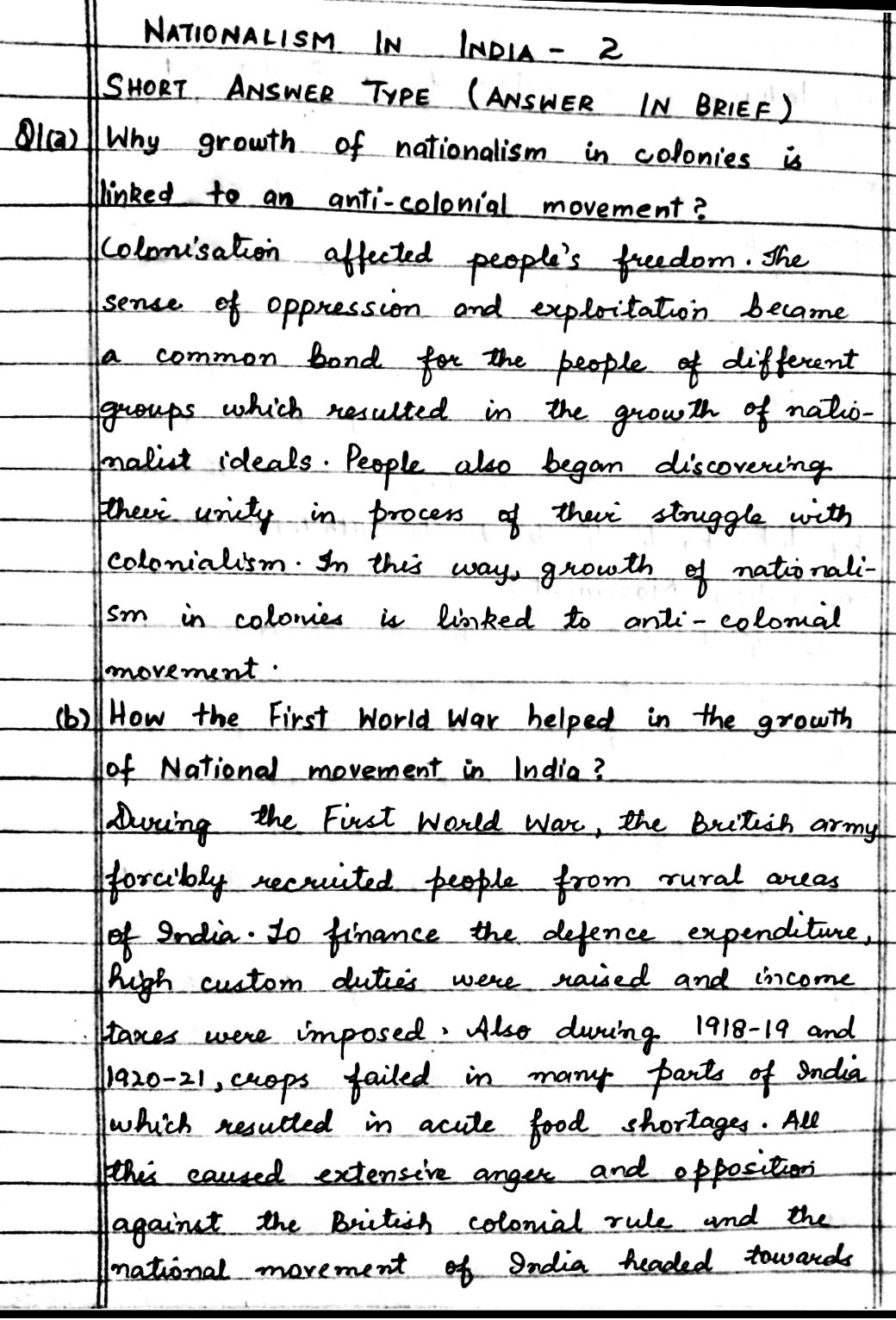
The Handwritten notes of Class 10 History provided by JKBNS are one of the rarest of rare study materials available online. These notes are written in clear handwriting unlike other handwritten notes available online that are available for free pdf download . These notes contain short history answers that are suited for every student.
Why Our Class 10 History Chapter 2 Notes are Effective
Before we go any further , let’s understand why handwritten notes are so highly recommended:
Enhanced Memory: The physical act of writing helps in better retention of dates, events, and names.
Visual Learning: They often include mind maps, flowcharts, and underlines that create strong visual cues.
Simplified Concepts: Good notes break down complex topics into easy-to-understand points, just like the ones we’re about to explore.
You can access JKBOSE Class 10 History Chapter 2 Solutions in handwritten format from our web portal. Before that you can have a view at the samples below :

Important Dates & Events Included in Nationalism in India Class 10 History Handwritten Notes – Quick Revision Table
For better understanding of the Class 10 History Chapter 2 Notes , the students need to remember the important Dates and events as it would help them excell with good marks.
| Year | Event |
|---|---|
| 1915 | Gandhi returns to India |
| 1919 | Rowlatt Act, Jallianwala Bagh Massacre |
| 1920 | Non-Cooperation Movement launched |
| 1922 | Chauri Chaura, withdrawal of NCM |
| 1928 | Simon Commission |
| 1929 | Lahore Congress, Purna Swaraj demand |
| 1930 | Salt March, Civil Disobedience begins |
| 1931 | Gandhi-Irwin Pact |
| 1932 | Poona Pact |
FAQs on Nationalism in India (CBSE & JKBOSE Focus)
Q1: What was the main cause of the Non-Cooperation Movement?
A: The movement was a direct response to the Rowlatt Act, the Jallianwala Bagh massacre, and the injustice of British rule, combined with the Khilafat issue.
Q2: Why did Gandhi call off the Non-Cooperation Movement?
A: He called it off immediately after the violent incident at Chauri Chaura in 1922, where a police station was burnt, killing policemen. He was a strict believer in non-violence.
Q3: What was the significance of the Salt March?
A: The Salt March was a brilliant symbolic act. Salt was a commodity used by every Indian, and the tax on it represented the tyranny of British rule. Breaking this law was a way for every Indian to defy the government.
Q4: How did the meaning of Swaraj differ for various social groups?
A: This is a crucial 5-mark question. For peasants, it was about no rent; for tribals, it was autonomy; for industrialists, it was economic protection; and for Congress, it was political independence.
Conclusion: Prepare with Confidence
Mastering the chapter on Nationalism in India requires understanding the interconnectedness of events and the perspectives of different groups. While this guide provides a solid digital summary, we highly recommend creating your own Nationalism in India Class 10 History Handwritten Notes . The process of writing will help you internalize the struggle, the strategies, and the spirit that shaped modern India.
Use this post as a supplementary for your notes, and you’ll be well-prepared to tackle any question answers from JKBOSE or CBSE Class 10 History Chapter 2. Good luck with your studies


