
Magnetic Effects of Electric Current Class 10 Science CBSE Notes: JKBOSE NCERT Solutions & PDF Download
Struggling in grasping or learning the subject of Class 10 Physics! If yes, then stay carefree as we bring to you some of the finest, easy to understand study material. And today, we have uploaded solutions for Class 10 Science Chapter 13 Magnetic Effects of Current. This chapter is a fascinating bridge between electricity and magnetism, explaining how one can create the other. It’s a crucial topic for both conceptual understanding and scoring high marks in your CBSE and JKBOSE board exams. Using Magnetic Effects of Electric Current Class 10 Science CBSE Notes will surely help you understand all the topics well.
For Notes Contact WhatsApp :
+919103270253
Whether you’re looking for a quick revision, detailed Magnetic effects of current question answers, or a complete set of handwritten notes, this blog post has you covered. We’ve structured these Class 10 Physics Notes to align perfectly with the NCERT textbook, ensuring you don’t miss any important concept.
Class 10 Science Chapter 13 Notes (Magnetic Effects of Electric Current) – Key Concepts
Let’s break down the chapter into easy-to-understand segments.
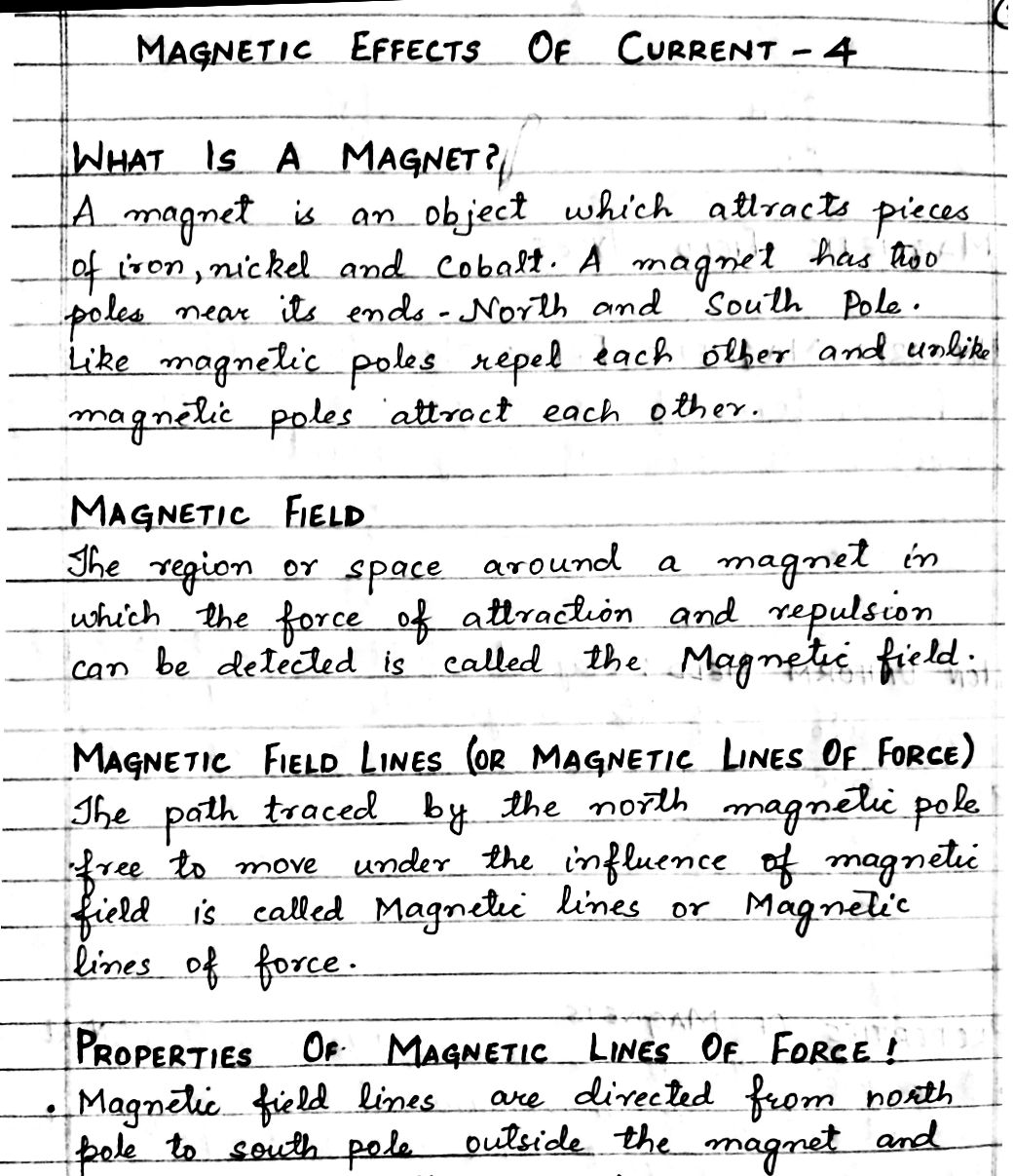
1. Magnetic Field and Field Lines
Magnet: A substance that attracts objects made of iron, cobalt, and nickel.
Magnetic Field: The region around a magnet where its force can be experienced. It is a vector quantity.
Magnetic Field Lines: These are imaginary lines that represent the magnetic field.
- They emerge from the North Pole and merge at the South Pole.
- The relative strength of the magnetic field is shown by how close the lines are to each other.
- They never intersect.
2. Magnetic Field due to a Current-Carrying Conductor
This is the core concept of the chapter. An electric current flowing through a conductor produces a magnetic field around it.
Right-Hand Thumb Rule: Imagine you are holding a current-carrying straight conductor in your right hand. If the thumb points in the direction of the current, the curled fingers will show the direction of the magnetic field lines.
Magnetic Field due to a Current-Carrying Straight Conductor: The field lines are concentric circles whose centers lie on the wire.
Magnetic Field due to a Current-Carrying Circular Loop:
- The magnetic field lines are nearly straight at the center and circular around the loop.
- The strength of the magnetic field is directly roportional to the:
1. Current flowing through the loop.
2. Number of turns in the loop.
Download Class 10 Science Chapter 13 Notes
A coil of many circular turns of insulated copper wire wrapped closely in the shape of a cylinder is called a solenoid.
- The magnetic field inside a solenoid is strong, uniform, and parallel to its axis—similar to the field of a bar magnet.
- The strength of the magnetic field increases with the number of turns and the current.
4. Electromagnet
A strong magnet formed by inserting a soft iron core inside a solenoid. Its magnetism can be switched on and off by controlling the electric current. Used in electric bells, motors, and cranes.
5. Force on a Current-Carrying Conductor in a Magnetic Field
When a current-carrying conductor is placed in a magnetic field, it experiences a force.
Fleming’s Left-Hand Rule: Stretch the thumb, forefinger, and middle finger of your left hand mutually perpendicular to each other. If the forefinger points in the direction of the magnetic field and the middle finger in the direction of the current, then the thumb will point in the direction of the force (motion) of the conductor.
This principle is the foundation of the Electric Motor.
6. Electric Motor
A device that converts electrical energy into mechanical energy.
Principle: It works on the principle that a current-carrying coil placed in a magnetic field experiences a force, causing it to rotate.
Key Components: Armature, Strong Magnet, Split Ring (Communtator), Brushes.
Uses: Fans, Mixers, Washing Machines, etc.
7. Electromagnetic Induction
Discovered by Michael Faraday, it is the phenomenon of generating an electric current in a closed circuit by changing the magnetic field around it.
Fleming’s Right-Hand Rule: Stretch the thumb, forefinger, and middle finger of your right hand mutually perpendicular. If the forefinger points in the direction of the magnetic field and the thumb in the direction of motion of the conductor, then the middle finger points in the direction of the induced current.
This is the principle behind Electric Generators.
8. Electric Generator (Dynamo)
A device that converts mechanical energy into electrical energy.
Types:
- AC Generator: Produces Alternating Current.
- DC Generator: Produces Direct Current.
- Uses: Power generation in power plants.
9. Domestic Electric Circuits
Live Wire (Red Insulation): Carries current from the mains to the appliance (at high voltage).
Neutral Wire (Black Insulation): Completes the circuit by providing a return path.
Earth Wire (Green Insulation): A safety measure to prevent electric shocks.
Short Circuit: Occurs when live and neutral wires come into direct contact.
Overloading: Happens when too many appliances are connected to a single socket, drawing current beyond the safe limit.
Magnetic Effects of Current Question Answers
Q1: State Fleming’s Left-Hand Rule.
A: Fleming’s Left-Hand Rule states that if we stretch the thumb, forefinger, and middle finger of the left hand so that they are mutually perpendicular, then the forefinger points in the direction of the magnetic field, the middle finger in the direction of the current, and the thumb gives the direction of the force on the conductor.
Q2: What is the difference between an AC generator and a DC generator?
A: The main difference is in the commutator. An AC generator uses slip rings, which produce an alternating current (AC). A DC generator uses a split-ring commutator, which produces a direct current (DC).
Q3: Why is the magnetic field inside a solenoid uniform?
A: The magnetic field lines inside a solenoid are parallel and equidistant, indicating that the strength and direction of the magnetic field are the same at all points, making it uniform.
For more detailed Magnetic effects of current solutions, refer to the NCERT solutions at the end of your textbook or trusted educational websites.
Download Resources
To aid your preparation, we have compiled the key points into an easy-to-review format.
[Magnetic Effects of Electric Current – Handwritten Notes PDF Download]
Our notes summarize the entire chapter with clear diagrams of Fleming’s rules, electric motors, and generators, making last-minute revision a breeze.
Summary of Magnetic Effects of Electric Current Class 10 Science CBSE Notes

Below is the tabular summary of Class 10 Science Our Environment Chapter :
| Total Chapters | 13 |
|---|---|
| Subject | Science (Physics) |
| Class | 10 |
| Name of Chapter & Chapter No | Magnetic Effects of Electric Current Chapter 13 |
| Medium | English |
NCERT Solutions & JKBOSE Syllabus:
While the core concepts remain the same, students following the JKBOSE curriculum should cross-check specific questions and exercise numbers with their prescribed syllabus. The fundamental NCERT solutions provide an excellent base for all students.
Read Also : Other Class 10 Physics Handwritten Notes :
- Chapter 10 Physics Light Class 10 Notes PDF Download
- Chapter 11 Human Eye and Colorful World Class 10 Notes
- Class 10 Physics Electricity Question Answers
Conclusion
Understanding the Class 10 Science Chapter 13 Magnetic Effects of Electric Current is essential not just for exams but also for grasping how many everyday appliances work. By focusing on the definitions, rules (Right-Hand Thumb, Fleming’s Left and Right-Hand), and device principles (Motor, Generator), you can easily master this chapter.
Use Magnetic Effects of Electric Current Class 10 Science CBSE Notes, practice the diagrams, and solve the back-exercise questions to confidently approach your board exams. Good luck!


