
Complete NCERT Class 10 Political Science Chapter 2 Federalism Notes
Understanding the concept of federalism is crucial for every Class 10 student studying Political Science. We provide comprehensive Political Science Chapter 2 Federalism Notes for Class 10th, tailored to help you grasp this key democratic principle. Whether you’re preparing for CBSE or JKBoSE exams, these structured notes will clarify concepts and boost your exam readiness.
Read Also : Class 10 Political Science Chapter 1 Power Sharing Question Answers
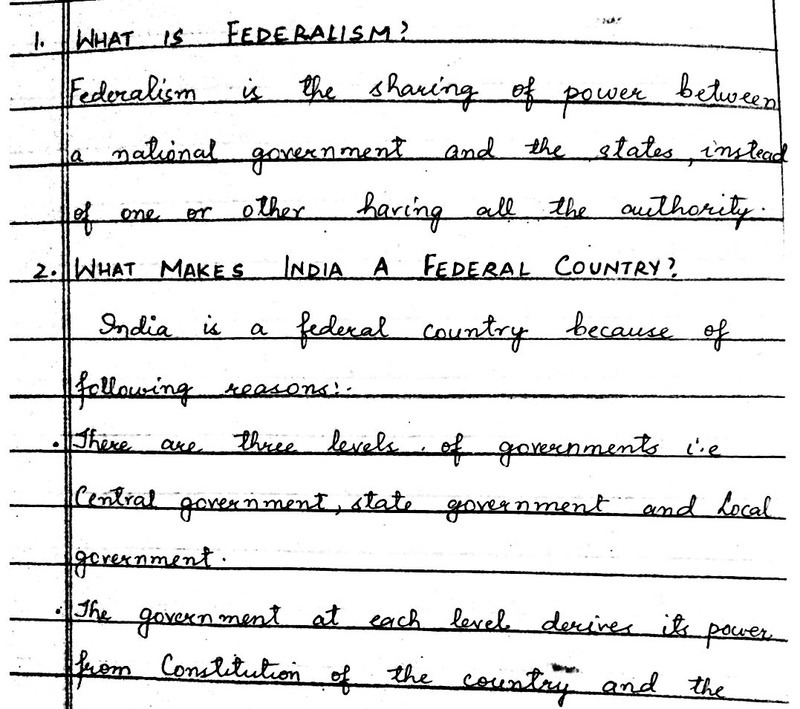
What is Federalism? A Simple Definition
Federalism is a system of government where power is divided between a central authority (like the Union Government in India) and various constituent units (like State Governments). This division ensures that no single level of government becomes too powerful, promoting balance and unity in diversity.
Key Features of Federalism from NCERT
As outlined in your NCERT textbook, federalism typically includes:
Two or More Levels of Government: Each level governs the same citizens, but has its own jurisdiction in specific matters like legislation, taxation, and administration.
Division of Power: Powers are clearly specified in the constitution to avoid conflicts. In India, this is detailed in the Union List, State List, and Concurrent List.
Supremacy of the Constitution: The constitution is the supreme law, and both levels of government must operate within its framework.
Independent Judiciary: A supreme court interprets the constitution and resolves disputes between different levels of government.
Dual Objectives: Federal systems aim to both safeguard and promote national unity, while also accommodating regional diversity.
How is India a Federal Country?
India’s federal structure is unique. The constitution declares India as a “Union of States.” Key aspects include:
Three-fold Distribution of Power:
Union List: Subjects of national importance like defence, foreign affairs, currency (97 subjects).
State List: Subjects of state and local importance like police, trade, agriculture (66 subjects).
Concurrent List: Subjects of common interest to both like education, forest, marriage (47 subjects). Both Union and State governments can make laws here.
Residuary Powers: Subjects not listed in any list fall under the Union Government (e.g., computer software).Holding Together Federation: India formed its federation bydividing power between the Union and the States, unlike the ‘coming together’ federations like the USA.
Decentralization in India: Power to the People
A major step in strengthening federalism was the 1992 Constitutional amendment to implement Panchayati Raj (rural local government) and Municipalities (urban local government). This is called decentralization—transferring power from state governments to local self-governments. It ensures democratic participation at the grassroots level.
Practice: Class 10 Federalism Question Answers
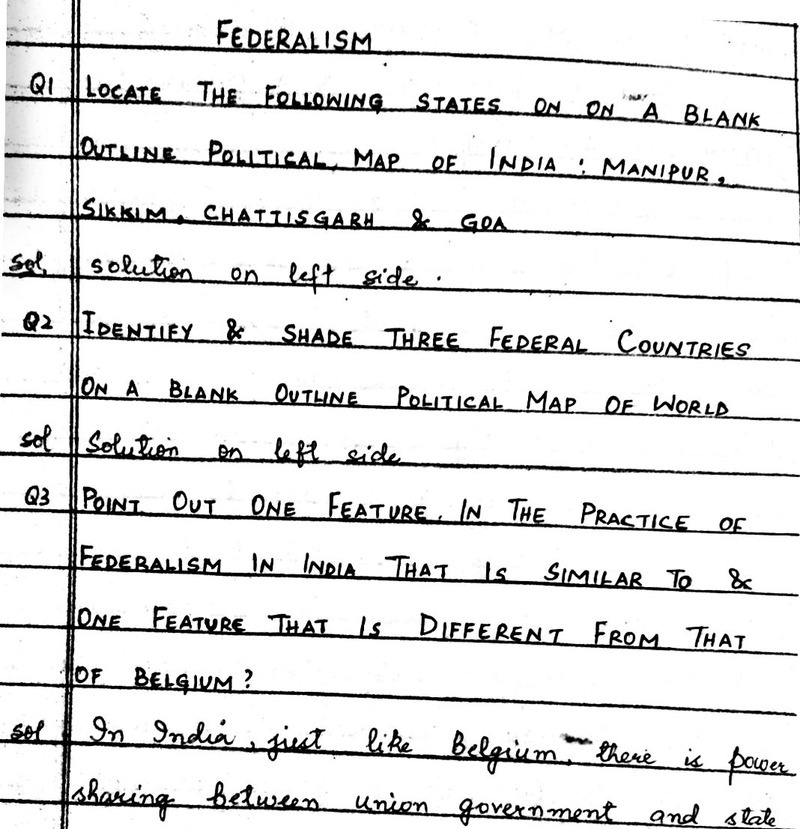
Q1: What are the two main objectives of a federal system?
A: The two main objectives are: (i) To safeguard and promote the unity of the country. (ii) To accommodate regional diversity.
Q2: Differentiate between the Union List and the State List.
A: The Union List contains subjects of national importance where only the Central Government can make laws (e.g., defence, atomic energy). The State List contains subjects of state and local importance where the State Governments can make laws (e.g., police, agriculture).
Q3: How is the Indian federal system different from that of the USA?
A: India is a ‘Holding Together’ federation where power is divided between the Union and States by the constitution. The USA is a ‘Coming Together’ federation where independent states came together to form a bigger unit. Also, in India, the Centre has more power in certain situations (like during an emergency) compared to the USA’s more rigid structure.
Exam Preparation Tips for CBSE & JKBoSE Students
✅Focus on Diagrams: Draw and learn the flowchart of the three lists (Union, State, Concurrent) for better visual memory.
✅Understand Key Terms: Be clear on terms like jurisdiction, unitary system, coalition government, and linguistic states.
✅Relate to Current Affairs: Link topics like coalition politics or centre-state disputes to the chapter to write impactful answers.
✅Practice Map Work: (For CBSE) Know the states that were created on a linguistic or cultural basis.
PDF Download Complete Notes of Federalism
A well-formatted PDF containing these notes, along with a mind map, important questions, and previous year’s question patterns, is an excellent revision tool. While we provide the structured content here, you can easily create your own personalized PDF download by compiling this information, ensuring you have an offline, portable study resource for Political Science Chapter 2 Federalism Notes for Class 10th.
Conclusion
Federalism is not just a textbook concept but a living reality of India’s democracy. It balances national integrity with regional aspirations. By mastering this chapter from your NCERT textbook, you not only prepare for exams like CBSE and JKBoSE but also build a foundational understanding of how India is governed. Use these notes as your primary guide, practice the Class 10 Federalism question answers regularly, and approach your exams with confidence.


