
JKBOSE Psychology Handwritten Notes for Class 11 PDF – Complete Syllabus & Free Download
Are you a JKBOSE Class 11 student struggling to find concise, exam-focused study material? Look no further. This blog post is your ultimate guide to JKBOSE Psychology Handwritten Notes for Class 11 – designed to help you master the entire syllabus, ace your theory paper (70 marks), and excel in practicals (30 marks).
Read Also : JKBOSE NCERT CBSE Class 12 Psychology ChapterWise Notes PDF Download
Psychology can feel overwhelming with its nine diverse units, ranging from the history of psychological thought to complex theories of emotion and memory. But with the right JKBOSE Psychology notes PDF, you can turn that challenge into your strongest subject. Below, we break down the complete syllabus, explain why handwritten notes are superior, and show you how to download your free copy instantly.
Click Here For Best, Short & Easy JKBOSE | CBSE | NCERT Handwritten & Full Notes
Why Choose Class 11 Psychology JKBOSE Handwritten Notes?
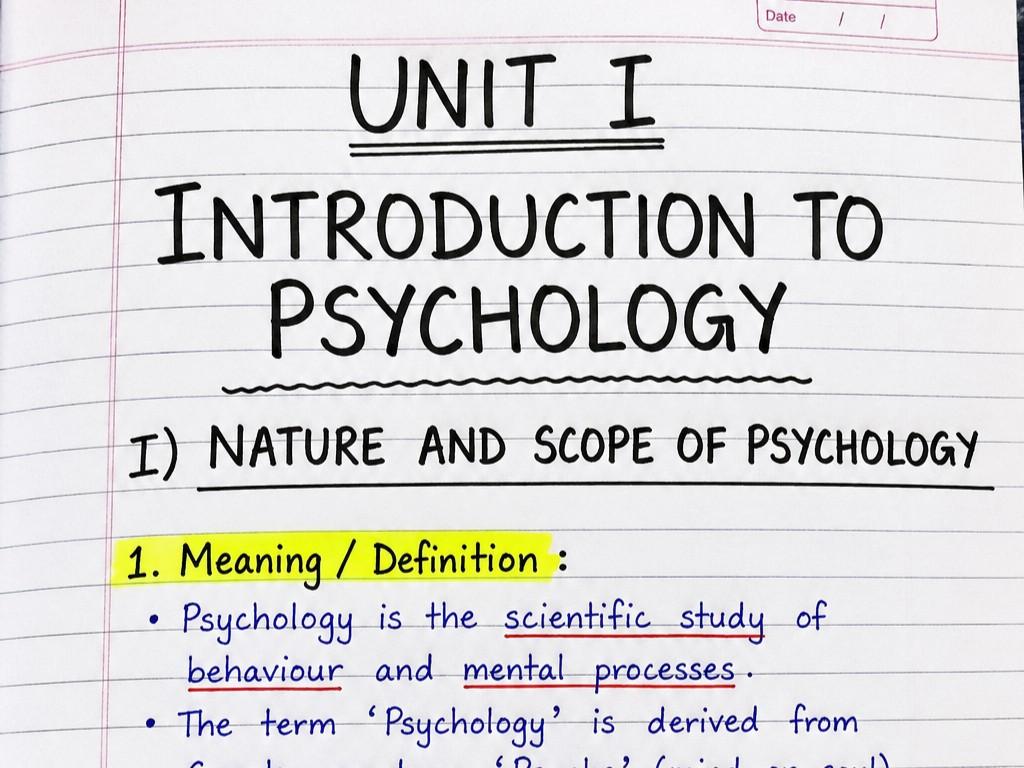
Unlike standard textbooks that often include excessive detail, Class 11 Psychology JKBOSE Handwritten Notes are crafted to highlight only what matters for your exams. These notes are:
- Exam-oriented: Focused on frequently asked questions, key definitions, and mark-wise distribution.
- Easy to revise: Pointwise explanations, flowcharts, and memory tricks.
- Plagiarism-free: Originally prepared by subject experts and toppers.
- Mobile & PC friendly: Clean formatting that reads well on any screen.
Whether you need to understand classical conditioning or Maslow’s hierarchy of needs, these notes simplify every concept.
Complete JKBOSE Class 11 Psychology Syllabus (Based on Official Blueprint)
Your theory paper carries 70 marks with a time limit of 3 hours. The practical exam is 30 marks. Below is the unit-wise breakdown exactly as per the JKBOSE curriculum.
Unit I – Introduction to Psychology (9 marks)
Nature and scope of Psychology
Brief historical background
Branches: Educational, Social, Abnormal, Experimental, Clinical, Industrial, Cognitive
Schools of thought: Structuralism, Functionalism, Behaviourism, Psychoanalysis
Unit II – Methods in Psychology (9 marks)
Observation, Experimental, Survey & Case Study methods
Psychological Testing: Characteristics, Reliability & Validity
Unit III – Human Development (9 marks)
Meaning of growth and development
Factors influencing development
Stages: Infancy, Childhood, Adolescence, Adulthood, Old Age
Unit IV – Sensory, Attentional and Perceptual Processes (8 marks)
Sensation, Attention, Perception
Laws of perceptual organization
Selective and Sustained Attention, Illusions
Sense Modalities
Unit V – Learning (9 marks)
Meaning and characteristics of Learning
Classical and Operant Learning, Observational Learning, Verbal Learning, Skill Learning
Factors facilitating Learning
Unit VI – Memory and Forgetting (9 marks)
Meaning of Memory & its components
Levels of processing: Sensory memory, Short-term memory, Long-term memory
Forgetting: Nature and Theories (Trace decay, Interference, Retrieval failure)
Unit VII – Thinking and Language (8 marks)
Nature of thinking
Process of thinking: Reasoning, Problem solving, Decision making
Creative thinking: Nature and process
Thought and Language, Development of Language
Unit VIII – Motivation (4 marks)
Meaning and Cycle of motivation
Psycho-social motives: Achievement, Affiliation, Power
Maslow’s Hierarchy of Needs
Unit IX – Emotions (5 marks)
Meaning and characteristics of emotion
Theories: James-Lange Theory, Cannon-Bard Theory
Emotional reactions: Happiness, Optimism, Anger, Fear
Note: The practical exam (30 marks) includes experiments, psychological testing, and viva voce. Our handwritten notes also include practical guidelines.
What Makes These Handwritten Notes Better Than Regular Guides?
Many students rely on printed guides or digital PDFs that are simply scanned from textbooks. In contrast, JKBOSE Psychology Handwritten Notes for Class 11 offer unique advantages:
- Visual memory boost: Handwritten text with underlining, arrows, and diagrams improves recall.
- Concise language: No unnecessary jargon – just clear, pointwise explanations
- Integrated examples: Real-life scenarios for every theory (e.g., Pavlov’s dog for classical conditioning, a student’s exam fear for James-Lange theory).
- Comparison tables: Quickly differentiate between Structuralism vs Functionalism, Classical vs Operant conditioning, and Trace decay vs Interference theory.
- Last-minute revision guides: Each unit ends with a 2-minute summary.
How to Download JKBOSE Psychology Handwritten Notes for Class 11
Getting your hands on this valuable JKBOSE study material is very simple. Follow these steps:
- Click the WhatsApp button (or link) provided below.
- You will be redirected to a WhatsApp chat with the number +919103270253.
- Send a message saying: “Psychology Notes Class 11”.
- Within seconds, you will receive a direct procedure for the complete PDF.
- Save the file to your phone or computer – no signup, no payment.
- This method is fast, secure, and works 24/7.
[👉 Click Here to Get Notes on WhatsApp: +919103270253]
(Just copy the number and send a message if you prefer manual texting.)
Unit-Wise Important Topics to Focus From the Notes
To help you plan your study schedule, here are the most critical sub-topics covered in our handwritten notes.
Unit I & II – Foundations & Methods
- Branches of psychology (memorize at least five with examples)
- Difference between Behaviourism and Psychoanalysis
- Reliability vs Validity in testing
- Advantages/disadvantages of Case Study method
Unit III – Human Development
- Differences between growth and development
- Role of heredity vs environment
- Adolescence: characteristics and challenges
Unit IV – Sensory & Perception
- Laws of perceptual organization (Gestalt: proximity, similarity, continuity, closure)
- Selective attention vs sustained attention
- Common illusions (Müller-Lyer, etc.)
Unit V – Learning
- Classical conditioning (UCS, UCR, CS, CR)
- Operant conditioning (positive/negative reinforcement, punishment)
- Observational learning (Bandura’s Bobo doll experiment)
Unit VI – Memory & Forgetting
- Diagram of Sensory → STM → LTM
- Three theories of forgetting with examples
- Ways to improve memory
Unit VII – Thinking & Language
- Steps in problem solving
- Creative thinking process (preparation, incubation, illumination, verification)
- Relationship between thought and language (Sapir-Whorf hypothesis)
Unit VIII – Motivation
- Maslow’s hierarchy from bottom to top
- Achievement, Affiliation, and Power motives – real-life identification
Unit IX – Emotions
- James-Lange theory: “We feel sad because we cry”
- Cannon-Bard theory: Simultaneous arousal and emotion
- Managing anger and fear
Tips to Score 60+ in JKBOSE Class 11 Psychology Exam
Using Class JKBOSE Psychology Handwritten Notes for Class 11 strategically can push your score from average to excellent. Follow these tips:
- Know the marks distribution: Units I, II, III, V, VI are heavy (9 marks each). Prioritize them.
- Practice diagrams: Draw Maslow’s pyramid, memory model, classical conditioning cycle – these impress examiners.
- Use Important Terms: In answers, always mention terms like reinforcement, schema, trace decay, perceptual organization – they fetch marks.
- Write examples: For every theory, add a daily-life example from your own experience.
- Revise from handwritten notes only: Three days before exam, stop using textbooks and just flip through your handwritten notes.
Frequently Asked Questions (FAQs)
1. Are these JKBOSE Psychology Handwritten Notes for Class 11 completely free?
No. The PDF is provided at some cost. Just message +919103270253 on WhatsApp, and you will receive the procedure to pdf download the Chapterwise Notes.
2. Do the notes include the practical exam syllabus?
Absolutely. There is a dedicated section on practical experiments, psychological tests, and viva questions commonly asked in JKBOSE practical exams.
3. Can I use these notes for other boards like CBSE or UP Board?
While the notes are based on the JKBOSE syllabus, most topics (learning, memory, motivation, emotions) are common across Indian boards. However, always cross-check with your specific curriculum.
4. How are these notes different from a standard PDF?
These are handwritten – which means better visual recognition, natural underlining, and a layout that mimics your own revision notes. Many students find handwritten notes easier to remember than typed text.
5. What if the WhatsApp number does not reply immediately?
The number +919103270253 is monitored regularly. You will receive an automated or quick manual response within a few minutes. If delayed, feel free to send a reminder.
6. Is there any limit on downloads?
No. Once you receive the link, you can download it on multiple devices and share it with your friends (for personal study use only).
Final Words
Mastering Psychology in Class 11 is not about memorizing every line of the textbook – it is about understanding concepts and revising smartly. With these JKBOSE Psychology Handwritten Notes for Class 11, you get a complete, exam-ready resource that fits in your pocket. No more carrying heavy books or wasting time making your own notes from scratch.
Get your paid / free PDF today and start studying smarter, not harder.


