
Motion Chapter 1 Handwritten CBSE Science Notes for Class 9th Physics
If you find hard to grasp the concepts of Motion in your CBSE Class 9 Science syllabus? You’re not alone. This foundational chapter in physics sets the stage for understanding how objects move in our universe. To help you excel, we’ve compiled a complete lesson summary that mimics detailed Handwritten CBSE Science notes for Class 9th Physics, complete with solved numericals and textbook question answers in free PDF download format.
Read Also : Tissues Chapter 6 Biology Handwritten Notes for CBSE Class 9
Motion Chapter 1 Handwritten CBSE Science Notes for Class 9th Physics comprises all key concepts, formulas, and problem-solving techniques. Practice graphs and numericals for thorough preparation. Futhermore these notes are compatible with JKBOSE and NCERT Syllabus. 9th Class Motion Solutions can also be found in this blog post making you perform 360 degrees.
Handwritten CBSE Science Motion Notes for Class 9th Physics
The first chapter in the NCERT books of class 9 science is named as Motion and it is covered in Physics domain. It starts with a brief introduction regarding the concept of motion and gradually moves on to uniform and non-uniform motion. Students will also learn about the graphical representation of motion and how to solve the numericals related to this topic. All this will be covered in our Handwritten CBSE Science Motion Notes for Class 9th Physics.
1. Introduction to Motion
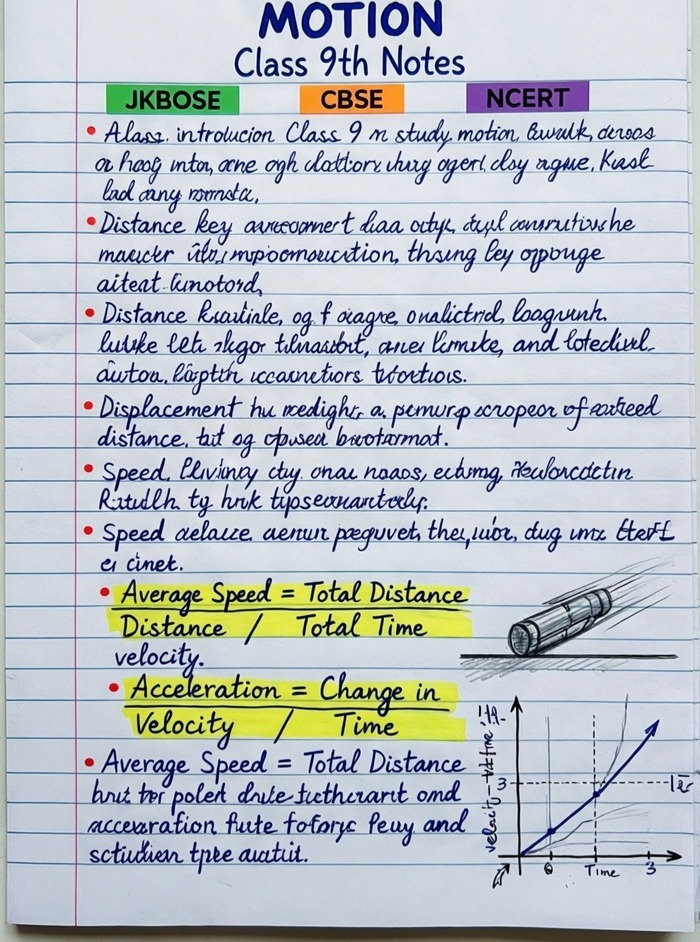
Motion is a fundamental concept in physics. An object is said to be in motion if its position changes with time relative to a fixed point called the reference point.
Key Definitions:
Reference Point: A fixed place or object used for comparison to determine if an object is moving.
Rest: An object is at rest if it does not change its position with respect to its surroundings.
Motion: An object is in motion if it changes its position with respect to its surroundings.
Click the below link to PDF Download 9th Class Motion Chapter 7 Notes:
Download Class 9th Chapter 1 Motion JKBOSE CBSE Notes Solutions
Types of Motion:
Rectilinear Motion: Motion along a straightp line (e.g., a car on a straight road).
Circular Motion: Motion along a circular path (e.g., a merry-go-round).
Rotational Motion: Spinning about an axis (e.g., a rotating fan).
Periodic Motion: Motion that repeats at regular intervals (e.g., a swinging pendulum).
2. Scalar and Vector Quantities
Scalar Quantity: Has only magnitude (e.g., distance, speed, mass, time).
Vector Quantity: Has both magnitude and direction (e.g., displacement, velocity, force).
3. Distance and Displacement
Distance:
- Total path length covered by an object.
- Scalar quantity.
- SI Unit: metre (m).
Displacement:
- Shortest distance between initial and final positions, with direction.
- Vector quantity.
- SI Unit: metre (m).
Example: If a person walks 4 km east and then 3 km north,
Distance = 7 km,
Displacement = 5 km northeast (using Pythagoras theorem).
4. Uniform and Non-uniform Motion
Uniform Motion: Equal distances covered in equal intervals of time (constant speed).
Non-uniform Motion: Unequal distances covered in equal intervals of time (variable speed).
5. Speed and Velocity
Speed:
- Rate of change of distance.
- Scalar quantity.
- Average Speed = Total distance travelled / Total time taken.
- SI Unit: m/s.
Velocity:
- Rate of change of displacement.
- Vector quantity.
- Average Velocity = Total displacement / Total time taken.
- SI Unit: m/s.
Uniform Velocity: Equal displacements in equal intervals of time (constant speed + fixed direction).
6. Acceleration
Rate of change of velocity.
Acceleration = (Change in velocity) / Time taken.
Vector quantity.
SI Unit: m/s².
Retardation/Deceleration: Negative acceleration (slowing down).
Uniform Acceleration: Equal changes in velocity in equal intervals of time.
7. Graphical Representation of Motion
Distance-Time Graph:
Slope gives speed.
Straight line → uniform speed.
Curved line → non-uniform speed.
Velocity-Time Graph:
Slope gives acceleration.
Area under graph gives displacement.
8. Equations of Uniformly Accelerated Motion
If an object starts with initial velocity u, accelerates uniformly at a, attains final velocity v in time t, and covers displacement s:
- v = u + at
- s = ut + ½ at²
- v² = u² + 2as
9. Uniform Circular Motion
Motion in a circular path with constant speed but changing velocity (direction changes).
Centripetal force acts towards the centre.
Example: Earth revolving around the Sun.
CBSE Class 9 Motion Numerical Questions Answers
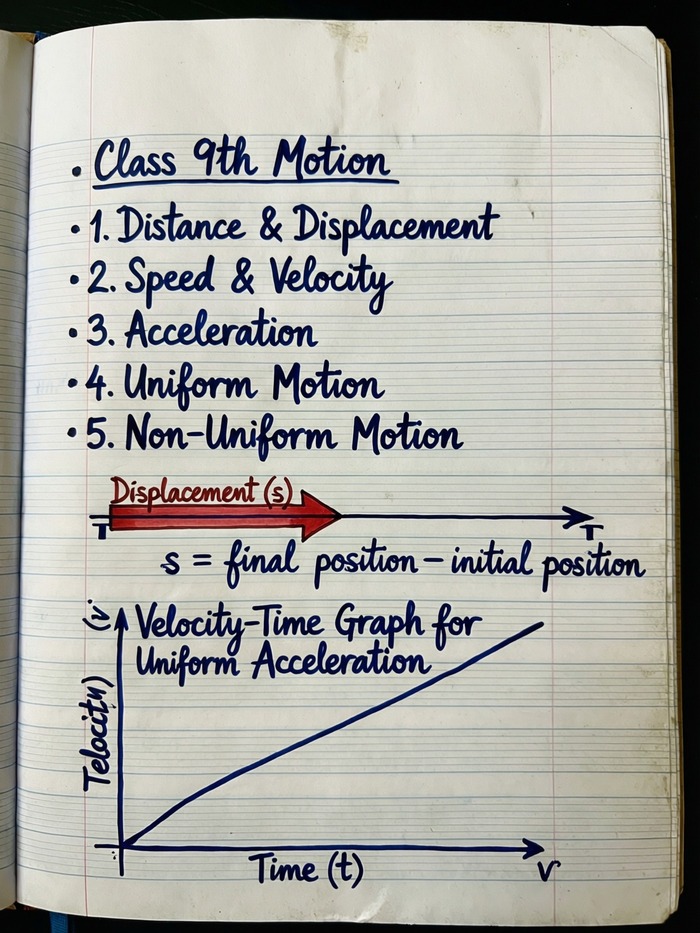
Have a look at Motion Numericals for Class 9th Phyics below. These Numericals will help you understand the chapter better. Practice Class 9 Motion Numerical Questions Answers thoroughly to excell in your Class 9 Board Exams.
Q1. A scooter acquires a velocity of 36 km/h in 10 seconds just after the start. Calculate its acceleration.
Given: u = 0 m/s, v = 36 km/h = 10 m/s, t = 10 s
Formula: a = (v – u)/t
Solution: a = (10 – 0)/10 = 1 m/s²
Q2. A train starting from rest attains a velocity of 72 km/h in 5 minutes. Find the acceleration and distance travelled.
Given: u = 0, v = 72 km/h = 20 m/s, t = 5 min = 300 s
Acceleration: a = (20 – 0)/300 = 1/15 m/s² ≈ 0.067 m/s²
Distance: s = ut + ½ at² = 0 + ½ × (1/15) × (300)² = 3000 m = 3 km
Q3. A car accelerates uniformly from 18 km/h to 36 km/h in 5 s. Find acceleration and distance covered.
Given: u = 18 km/h = 5 m/s, v = 36 km/h = 10 m/s, t = 5 s
Acceleration: a = (10 – 5)/5 = 1 m/s²
Distance: s = ut + ½ at² = 5×5 + ½×1×25 = 25 + 12.5 = 37.5 m
Motion Textual Questions Answers for Class 9th JKBOSE, NCERT
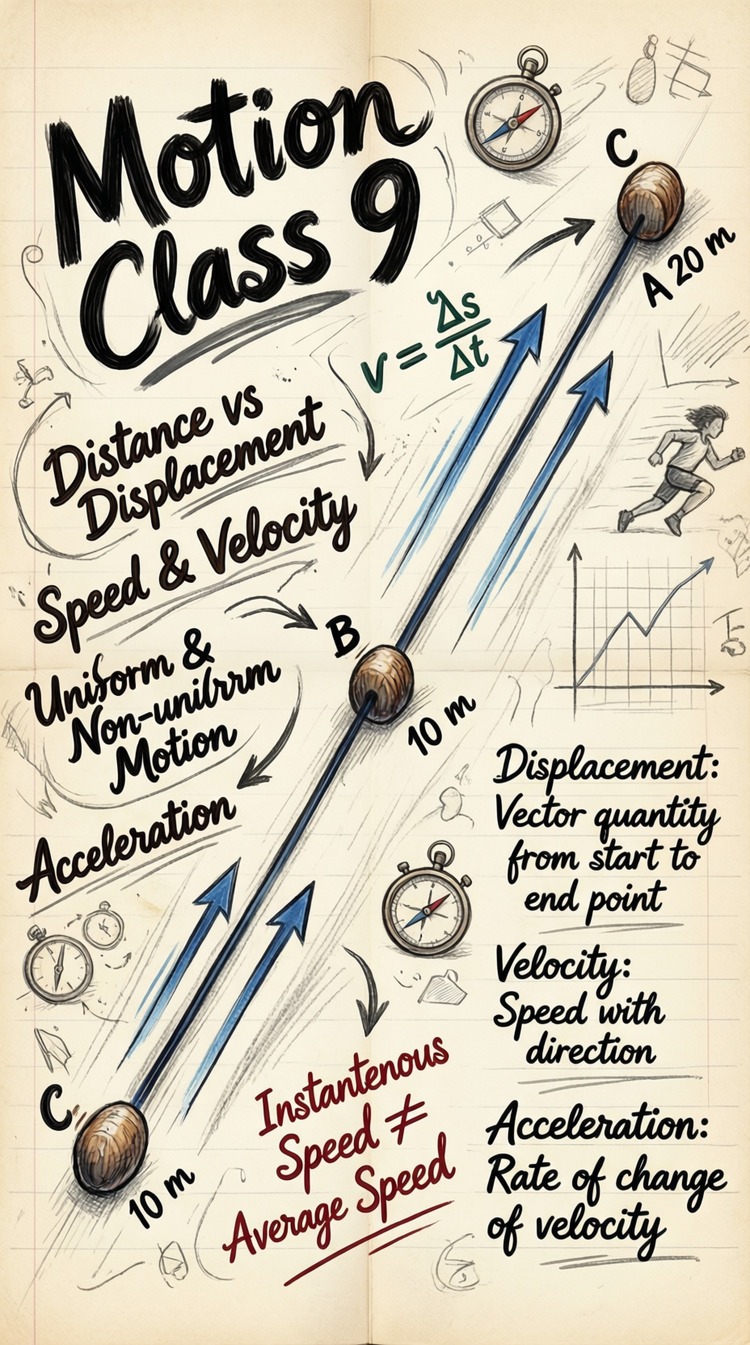
Here in this section, the students will get the textbook question answers of Motion Chapter. But you can’t get all the question answers. For that you would have to refer to our detailed notes that will prepare you and will make you attempt Class 9th Motion Solutions.
Q1. Distinguish between distance and displacement.
| Concept | Type | Description |
|---|---|---|
| Distance | Scalar quantity | Total path length |
| Displacement | Vector quantity | Shortest distance from initial to final point |
| Distance | Scalar quantity | Always positive |
| Displacement | Vector quantity | Can be positive, negative, or zero |
Q2. What is uniform motion? Give an example.
When an object covers equal distances in equal intervals of time, it is in uniform motion. Example: A car moving on a straight highway at 60 km/h constantly.
Q3. Can displacement be zero even if distance is not? Explain.
Yes. If a person runs around a circular track and returns to the starting point, distance covered is not zero, but displacement is zero.
Q4. What does the slope of a distance-time graph indicate?
The slope of a distance-time graph gives the speed of the object.
Q5. Define acceleration. What is its SI unit?
Acceleration is the rate of change of velocity with time. SI unit is m/s².
Q6. A train is moving with a velocity of 90 km/h. When the brakes are applied, retardation is 0.5 m/s². Find the time taken to stop.
u = 90 km/h = 25 m/s, v = 0, a = -0.5 m/s²
Using v = u + at ⇒ 0 = 25 + (-0.5)t ⇒ t = 50 seconds.
Important Points to Remember for Exams
- Motion is relative and depends on the reference point.
- Distance is path-dependent; displacement is position-dependent.
- Velocity includes direction; speed does not.
- Acceleration can be due to change in speed or direction.
- Area under v-t graph = displacement.
- Slope of d-t graph = speed.
- In uniform circular motion, speed is constant but velocity changes.
Conclusion & PDF Download Ready
Motion Chapter 1 Handwritten CBSE Science Notes for Class 9th Physics cover all key concepts, formulas, and problem-solving techniques. Practice graphs and numericals for thorough preparation.
This chapter on Motion is your first step into the logical world of physics. By focusing on definitions, practicing the three equations, and understanding graphs, you can score full marks. Think of this guide as your set of perfect Handwritten CBSE Science notes for Class 9th Physics—concise, focused, and exam-oriented.
Ready to test yourself? Try solving a problem where a train accelerates uniformly from rest and calculate the distance it covers in a given time. Check your answer using the second equation of motion and get help from Motion Textual Questions Answers


