
Access CBSE Handwritten Notes of Class 9 Chapter 10 Gravitation | PDF Download
If you are in Class 9, you’ve probably already noticed that science gets different around Chapter 10. Suddenly, you’re not just reading about plants or cells—you’re dealing with forces that literally hold the universe together. Gravitation is one of those topics that sounds intimidating at first, but once it clicks, it actually becomes pretty fascinating.
Gravitation is an interesting chapter that connects the dots between earthly phenomena and cosmic events. With the right study material, such as our detailed CBSE Handwritten Notes of Class 9 Chapter 10 Gravitation, you can simplify complex topics and ace your exams.
Read Also : Motion Chapter 1 Handwritten CBSE Science Notes for Class 9th Physics
Whether you are looking for a quick PDF download, need to practice question answers, or are specifically searching for JKBOSE relevant content, this guide has you covered.
What Makes Gravitation An Important Chapter?
Think about it. Gravity affects everything we do. It’s why:
- Your pen falls when you drop it
- Planets stay in their orbits without floating away
- Ships don’t sink despite weighing thousands of tons
- You feel heavier in an elevator going up and lighter when it goes down
Once you start seeing gravity everywhere, the chapter stops being just another exam topic and starts making sense in real life.
Click below to download the full free PDF download notes. Keep them handy, study regularly, and you’ll find that gravitation becomes one of your strongest chapters.
Download Gravitation Notes for Class 9
Use Password : 23
Why Gravitation Class 9th Handwritten Notes Work
Look, I get it. Downloading typed notes is easy. But here’s the thing about physics—especially gravitation—you need to see the derivations unfold step by step. That’s where handwritten notes shine.
Our CBSE Handwritten Notes of Class 9 Chapter 10 Gravitation include:
- Neatly written derivations that you can follow along with
- Diagrams drawn to show exactly how forces act on objects
- Important points circled or underlined so they catch your eye during revision
- Margin space where you can add your own notes or doubts
Important Question Answers You Should Practice
Exams love asking specific questions from this chapter. Here are some you’ll definitely want to prepare.
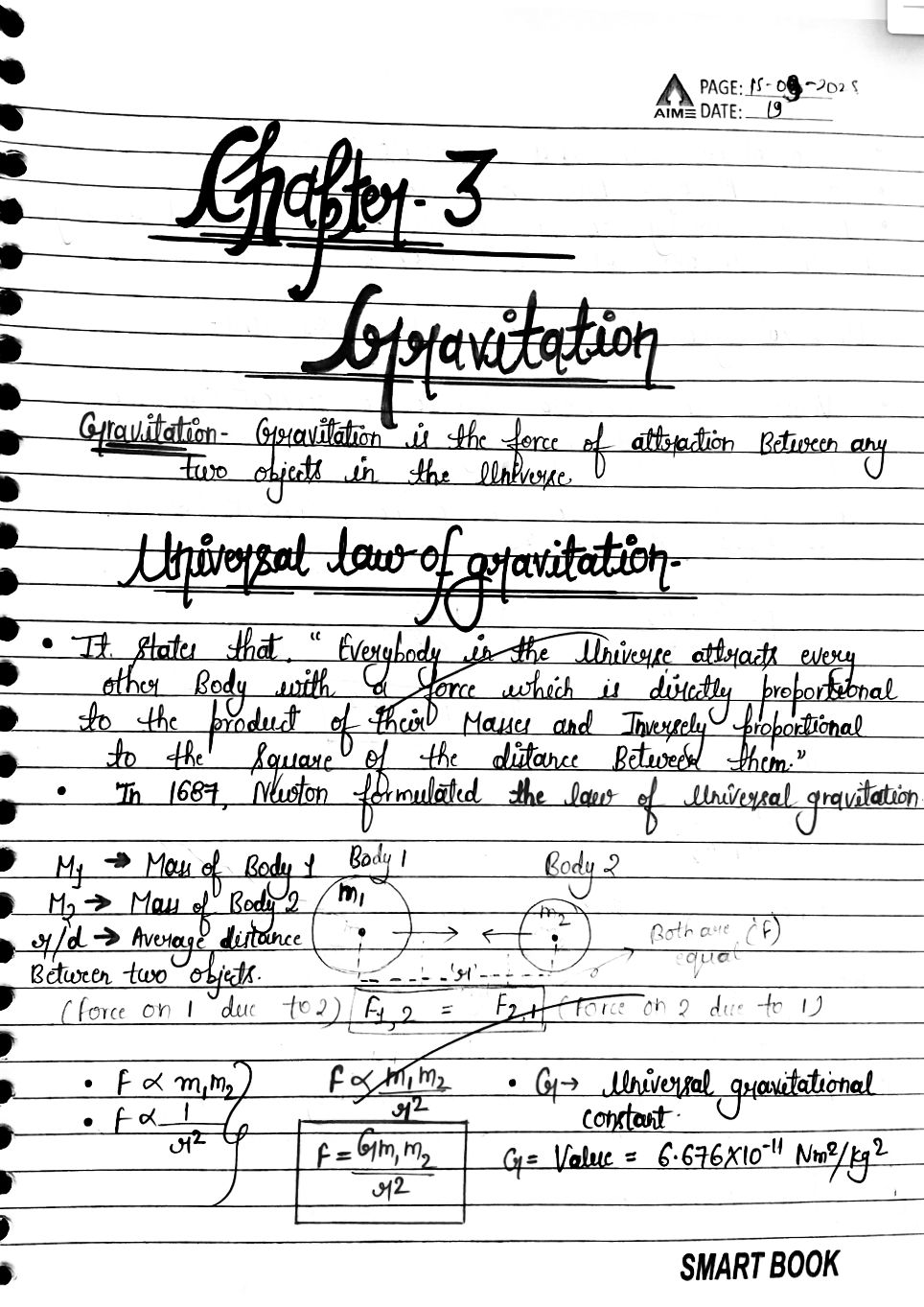
Q: State the Universal Law of Gravitation in your own words.
A: Every particle in the universe pulls on every other particle. The strength of this pull on how massive they are and how far apart they’re placed. Double the mass, double the force. Double the distance, and the force becomes one-fourth.
Q: Derive the relation between g and G.
Start with force equations. Gravitational force = GMm/R^2. Also, weight = $mg$. Since both represent the same force, equate them: mg = GMm/R^2. Cancel m from both sides, and you get g = GM/R^2.
Q: Why does a balloon filled with helium rise upward?
A: Helium is much lighter than air. The weight of the helium plus the balloon is less than the weight of the air it displaces. So the buoyant force upward is stronger than gravity’s pull downward, and up it goes.
Q: Why does a balloon filled with helium rise upward?
A: Helium is much lighter than air. The weight of the helium plus the balloon is less than the weight of the air it displaces. So the buoyant force upward is stronger than gravity’s pull downward, and up it goes.
Q: Calculate your weight on the Moon if your mass is 50 kg. (Given: Moon’s g = 1.63 m/s²)
A: Weight on Moon = mass × Moon’s gravity = 50 × 1.63 = 81.5 newtons. Compare this to Earth weight: 50 × 9.8 = 490 newtons. You’d feel amazingly light up there.
Good News for JKBOSE Students
If you’re studying under JKBOSE, you might worry that CBSE notes won’t match your syllabus. Relax—for Class 9 Science, the core physics chapters are practically identical. Both boards follow NCERT guidelines, so gravitation is covered the same way.
These notes work perfectly for you. The derivations, the formulas, the explanations—they’re all board-agnostic.
JKBOSE and CBSE: Syllabus Alignment
If you are a JKBOSE student, you might worry about syllabus differences. The good news is that for Class 9 Science, the core physics topics remain largely the same across CBSE and JKBOSE boards. The concepts of gravitation, the law of gravitation, and Archimedes’ principle are universally standard.
Our CBSE Handwritten Notes of Class 9 Chapter 10 Gravitation are fully aligned with the NCERT curriculum, making them equally effective for JKBOSE board exam preparation.
Wrapping It Up
Gravitation isn’t just another chapter to get through. It’s your introduction to how the universe actually works. The force that keeps the Moon circling Earth is the same one that pulls raindrops down. That’s pretty incredible when you think about it.
With the right resources—like our CBSE Handwritten Notes of Class 9 Chapter 10 Gravitation—you can build a solid foundation. Use them alongside your textbook, practice the question answers, and refer to them for JKBOSE preparation if that’s your board.


